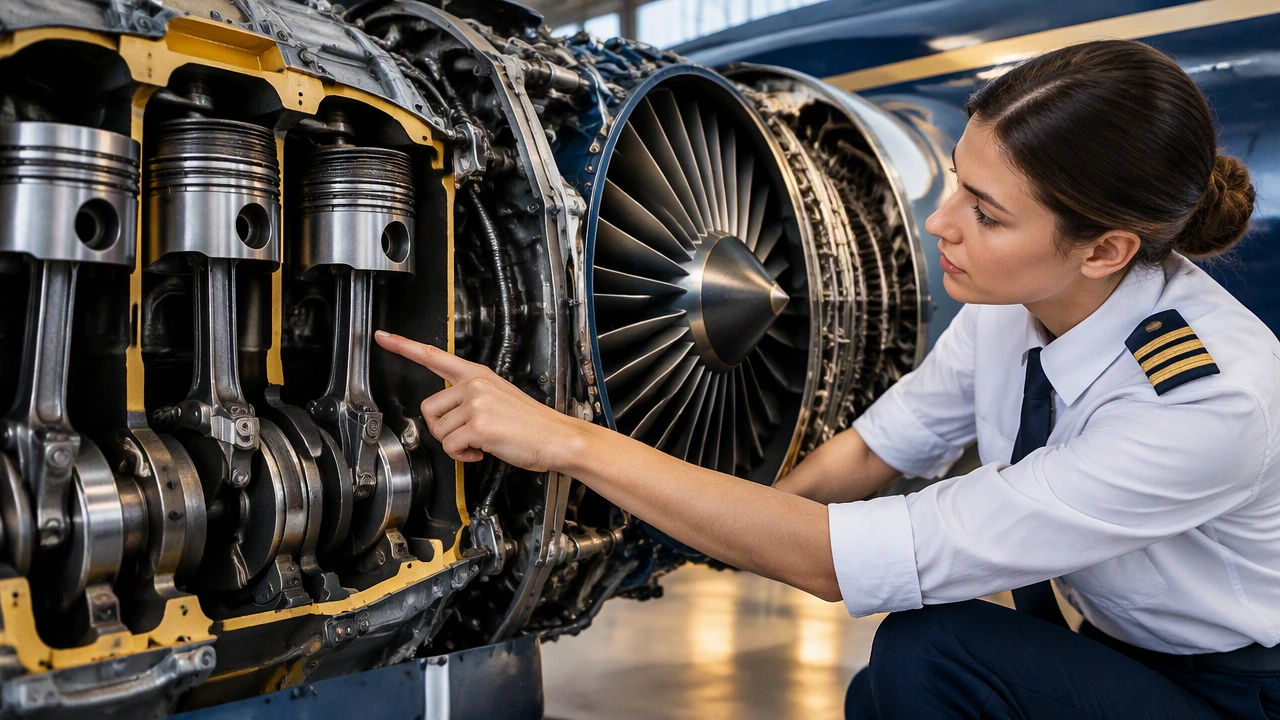
How Aircraft Engines Work: Piston Power and Turbine Basics for Pilot Training
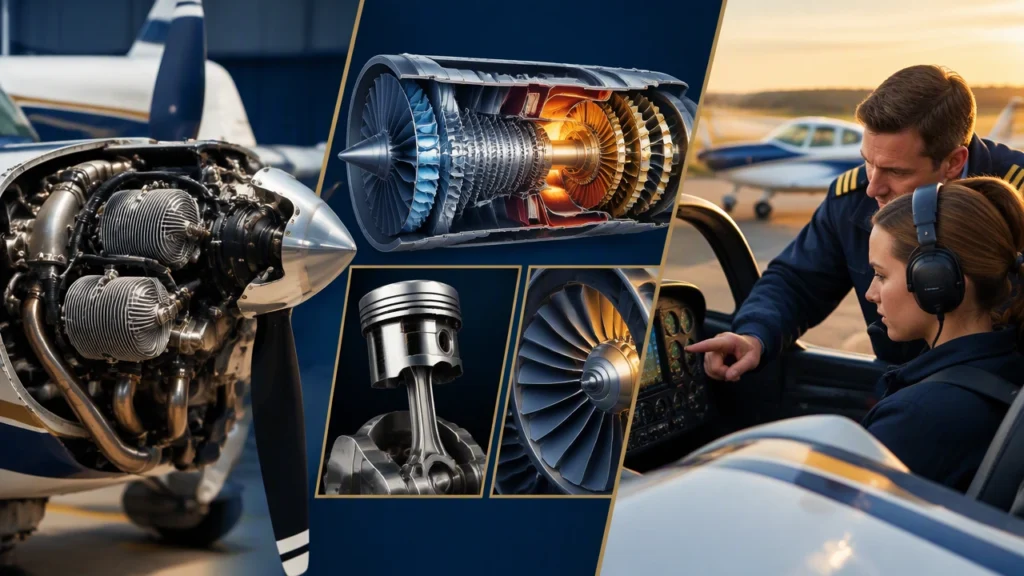
One of the first steps in pilot training is understanding the machine that keeps an airplane moving through the sky. An aircraft engine is more than a source of noise and speed; it is a carefully designed system that converts fuel and air into mechanical energy, then uses that energy to produce thrust. Whether you fly behind a piston engine or a turbine, knowing how the powerplant works helps you operate it safely, interpret instrument readings, and make better decisions in the air.
When people search for how do piston aircraft engines work, they are usually looking for a clear picture of what happens inside the cylinders and how that motion turns the propeller. Turbine engines follow different principles, but both types share a common goal: keep the airplane flying with reliable, manageable power.
The four-stroke piston engine in simple terms
Most training aircraft use a four-stroke, normally aspirated piston engine. The cycle repeats in every cylinder and is often remembered as intake, compression, power, and exhaust. During intake, the piston moves down and draws in a mixture of air and fuel. The intake valve is open, and the engine is essentially filling the cylinder with the ingredients it needs for combustion.
On the compression stroke, the valves close and the piston moves upward, squeezing the mixture into a much smaller space. This compression raises pressure and temperature, preparing the charge for ignition. Near the top of the stroke, the spark plugs fire, and the burning mixture pushes the piston back down with significant force. That is the power stroke, and it is where the engine actually produces energy. Finally, the exhaust stroke pushes spent gases out through the exhaust valve so the cycle can start again.
The pistons do not turn the propeller directly. Instead, they push on connecting rods, which rotate a crankshaft. The crankshaft is geared or coupled to the propeller, so as it spins, the propeller accelerates a large mass of air backward. The reaction to that acceleration is forward thrust, which is what moves the airplane through the air.
Fuel, air, and engine management
A piston aircraft engine needs the right fuel-air ratio to run smoothly. Too lean, and the engine may run hot and risk damage. Too rich, and it may waste fuel, produce lower power, and foul spark plugs. In many training airplanes, the pilot controls mixture with a mixture lever, adjusting it for altitude, temperature, and power setting. At higher altitudes, where the air is less dense, the mixture is typically leaned to maintain efficient combustion.
Engine instruments help the pilot monitor health and performance. Manifold pressure shows how much air-fuel mixture is entering the engine. Tachometer RPM shows how fast the crankshaft and propeller are turning. Oil pressure, oil temperature, and cylinder head temperature provide direct clues about lubrication and cooling. In a well-maintained engine operated within approved limits, these readings remain stable and predictable.
Cooling is just as important as combustion. Air-cooled aircraft engines use fins on the cylinders and carefully designed cowl openings to direct airflow. Oil also carries heat away from internal parts. That is why pilots pay attention to both cylinder head temperature and oil temperature, especially during climbs, hot days, or extended ground operations.
Propellers: turning engine power into thrust
A propeller is not a simple fan. Each blade is shaped like a small airfoil. As it spins, it creates lower pressure ahead of the blade and higher pressure behind it, pulling the airplane forward. The pitch of the blade, its angle relative to the airflow, affects how much air the propeller grabs. A fixed-pitch propeller is set for a compromise between takeoff and cruise performance. A constant-speed propeller allows the pilot to set a desired RPM, and a governor adjusts blade pitch automatically to maintain it.
From a pilot’s perspective, the propeller is the link between engine power and airplane performance. More RPM and higher manifold pressure generally mean more thrust, but they also mean higher fuel flow, higher temperatures, and more stress on the engine. Learning to balance these factors is a core part of pilot training.
Turbine engines: jet and turboprop basics
Turbine engines operate on a continuous cycle rather than the repeating strokes of a piston engine. In a turbojet or turbofan, air enters the front and is compressed by spinning compressor stages. Fuel is added in the combustion section, and the burning mixture produces hot, expanding gases. Those gases pass through turbine stages, which extract enough energy to keep the compressor running, and then exit the engine at high speed. The reaction to that high-speed exhaust produces thrust.
In a turboprop, the turbine drives a shaft connected to a propeller through a reduction gearbox. Most of the engine’s energy goes into turning the propeller, and only a small amount comes from jet exhaust. Turboprops are common in regional airliners, cargo aircraft, and some high-performance piston replacements because they offer strong performance, smooth operation, and reliable power at altitude.
Turbine engines respond differently from piston engines. They spool up smoothly, tolerate high altitudes well, and often use a single power lever rather than separate throttle and mixture controls. However, they require careful attention during start-up, are sensitive to foreign object damage, and operate at very high internal temperatures. Pilots transitioning to turbine aircraft learn new rhythms and new limits, even though the basic purpose, producing thrust to keep the airplane flying, remains the same.
Why understanding engines matters in flight training
Knowing how your engine works makes you a safer, more confident pilot. If a gauge moves out of range, you can reason about what might be happening instead of reacting with guesswork. If performance seems lower than expected on a hot day, you can connect density altitude, mixture settings, and engine output. If you plan a long cross-country, you can match fuel burns and power settings to time and distance.
Engine knowledge also supports good decision-making on the ground. Preflight inspections, fuel sampling, and oil checks are not just routine; they are the first line of defense against in-flight problems. When you understand why clean fuel, correct oil level, and intact spark plugs matter, you are more likely to catch small issues before they become big ones.
Key takeaways
- Piston aircraft engines convert fuel and air into mechanical energy through intake, compression, power, and exhaust, then turn the propeller with a crankshaft.
- Mixture control, cooling, and engine instruments help pilots keep the powerplant within safe operating limits.
- Propellers turn engine power into thrust, and their design affects both takeoff and cruise performance.
- Turbine engines, including turboprops, use continuous compression, combustion, and exhaust to produce thrust or drive a propeller through a gearbox.
- Understanding engines improves in-flight decision-making, preflight discipline, and overall safety throughout pilot training.
Whether you are studying for your first discovery flight or building time toward a new certificate, the engine is one of your most important systems. Learn its language, respect its limits, and it will reward you with dependable power every time you take the runway.